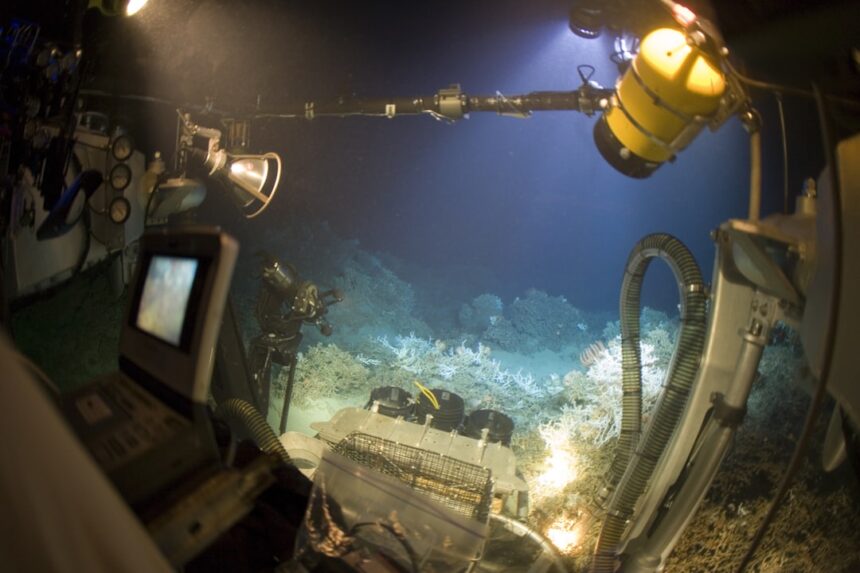
You stand at the precipice of a new frontier, not one of stars, but of the abyssal plains. Deep sea mining, a concept once relegated to speculative fiction, is now a tangible prospect, driven by the insatiable demand for minerals and a burgeoning financial architecture eager to capitalize on it. This is not merely about extracting resources; it’s about the financialization of geography, transforming the last unexplored wilderness on Earth into a commodity, a source of profit, and a canvas for investment strategies.
The ocean floor, a realm of perpetual darkness and immense pressure, holds vast deposits of minerals that are increasingly scarce on land. Polymetallic nodules, rich in copper, nickel, cobalt, and manganese – crucial components for batteries, electronics, and renewable energy technologies – litter the abyssal plains. Seamounts and hydrothermal vents, characterized by their intensely mineralized deposits, offer even richer concentrations of rare earth elements and precious metals.
The Shifting Landscape of Resource Scarcity
You’ve witnessed the geopolitical shifts, the supply chain vulnerabilities, and the rising costs associated with terrestrial mining. Nations and corporations are actively seeking alternative sources to secure their future resource needs. The deep sea, with its untapped reserves, presents a compelling, if challenging, proposition. This shift is driven by a pragmatic assessment of declining accessible land-based ore grades and the increasing difficulty and social opposition faced by traditional mining operations. The potential for a significant, long-term supply of critical minerals is a powerful incentive.
Quantifying the Unquantifiable: Early Assessments and Projections
Estimates surrounding the economic potential of deep sea mining vary wildly, reflecting the inherent uncertainties of exploring such an alien environment. However, even conservative projections suggest trillions of dollars in potential mineral wealth. These figures serve as potent attractors for investors, painting a picture of exceptionally high returns on investment. The challenge lies in the nascent stage of these assessments; they are based on limited surveys and extrapolations, making them inherently fluid and subject to significant revision as exploration progresses.
The Arbitrage of Accessibility: Cost Differentials and Market Opportunity
The financial appeal of deep sea mining is partly rooted in the perceived arbitrage between the cost of extracting from the deep sea and the cost of obtaining those same minerals from land-based sources. While initial exploration and extraction technologies are undoubtedly expensive, the unique mineral compositions and high concentrations found in certain deep-sea deposits could, in theory, lead to lower processing costs and higher purity end products. This potential for reduced extraction and processing costs, when coupled with rising land-based commodity prices, forms a key part of the financial narrative.
The concept of deep sea mining has garnered significant attention in recent years, particularly in the context of financialized geography and investment strategies. An insightful article that delves into this topic is available at Productive Patty, where it explores the implications of investing in underwater resources and the potential economic benefits and environmental concerns associated with such ventures. This piece provides a comprehensive overview of how financial markets are increasingly looking towards the ocean floor as a new frontier for resource extraction, highlighting the intersection of finance, geography, and environmental stewardship.
The Architects of Abyssal Wealth: Financing the Expedition
The immense capital required for deep sea mining necessitates sophisticated financial structures and a diverse range of investors. From venture capital firms eyeing future profits to established mining corporations and even national development funds, the financing landscape is complex and multi-layered. The very act of financing the exploration and extraction of a new geographical frontier is itself a financial innovation.
The Role of Sovereign Wealth Funds and National Interests
Certain nations, recognizing the strategic importance of the minerals found in their Extended Economic Zones (EEZs) or in international waters, are channeling significant investment through their sovereign wealth funds. These funds, often flush with capital from resource-based economies or fiscal surpluses, see deep sea mining as a long-term investment in economic diversification and national security. This institutional backing provides a crucial layer of stability and long-term vision, attracting other private sector investors who might otherwise find the risk profile too high.
Venture Capital and Private Equity: The High-Risk, High-Reward Play
Venture capital and private equity firms are drawn to the transformative potential of deep sea mining. They are willing to undertake the significant risks associated with novel technologies and an unproven operational environment in pursuit of substantial returns. These entities often play a crucial role in the early stages of exploration and technology development, providing the seed funding necessary to overcome initial hurdles and demonstrate the viability of the enterprise. Their involvement signals a belief in the disruptive potential of this new industry.
The “Green” Premium: Investor Appetite for Critical Minerals and ESG Pressures
Paradoxically, even as environmental concerns loom large, there’s a growing investor appetite for the minerals that fuel the green transition, such as cobalt for batteries and nickel for electric vehicles. Environmental, Social, and Governance (ESG) considerations, while often framed as a hurdle, can also be a driver. Investors seeking to align their portfolios with the global shift towards sustainability might view investments in these critical minerals, especially those promising greater supply chain security, as a necessary component of a “green” portfolio, albeit with significant caveats regarding actual environmental impact.
Blended Finance and Public-Private Partnerships: Mitigating Risk and Fostering Innovation
To de-risk investments and accelerate technological development, blended finance models and public-private partnerships are becoming increasingly prevalent. These arrangements combine public funding, often in the form of grants or low-interest loans, with private capital. This sharing of risk can unlock investment that might otherwise be unattainable, particularly for the pioneering stages of research and development. It also facilitates a degree of oversight and collaboration that can, in theory, promote more responsible development.
The Financial Cartography: Mapping Profitability in the Deep
The concept of financialized geography extends to the very act of mapping – not just the physical terrain, but the economic potential of that terrain. Financial models are being developed to quantify the estimated value of mineral deposits, predict extraction costs, and forecast market prices, effectively creating a new layer of economic cartography.
Geostatistical Modeling and Resource Prediction: The Digital Prospector
Advanced geostatistical techniques are being employed to interpret seismic data, seabed surveys, and core samples. These sophisticated models aim to predict the precise location, size, and grade of mineral deposits. The accuracy of these models is paramount, as they directly inform investment decisions and the allocation of capital. Mistakes in resource prediction can lead to significant financial losses, making this area a critical focus for financial strategists.
Cost-Benefit Analysis in Extremis: Engineering Probabilities for Profit
The engineering and operational costs of deep sea mining are staggering. You must consider the development of specialized vessels, remotely operated vehicles (ROVs), subsea processing equipment, and the logistics of bringing extracted minerals to the surface. Financial analyses therefore involve intricate calculations of capital expenditure, operational expenditure, labor costs, energy consumption, and unforeseen contingencies in an environment where equipment failure can have catastrophic financial consequences.
Risk Assessment and Mitigation: Navigating the Unknowns
The inherent risks associated with deep sea mining are multifaceted. These include technological risks (equipment failure in extreme conditions), geological risks (unforeseen seabed topography or deposit variability), environmental risks (potential damage to marine ecosystems), and geopolitical risks (evolving international regulations and potential disputes over resource rights). Financial models must incorporate these risks to determine appropriate insurance, reserve capacities, and acceptable levels of investor exposure.
The Discount Rate Dilemma: Valuing Future Returns in a Novel Industry
Determining the appropriate discount rate for future cash flows is a significant challenge. In established industries, historical data provides a basis for this. However, deep sea mining is nascent. Investors must grapple with a high degree of uncertainty regarding future market demand for specific minerals, the efficiency of future extraction technologies, and the evolving regulatory landscape. A higher discount rate will, of course, reduce the present value of future profits, influencing investment decisions.
The Geopolitics of Abyssal Capital: Control and Competition
The financialization of the deep sea is inextricably linked to geopolitical power dynamics. Control over these vast mineral resources translates into economic leverage and strategic advantage, fostering intense competition among nations and corporations.
The International Seabed Authority (ISA) and the “Common Heritage of Mankind”
The International Seabed Authority (ISA), established under the UN Convention on the Law of the Sea (UNCLOS), is tasked with regulating mineral-related activities in the international seabed area – the “Area.” Its mandate includes ensuring that exploitation benefits all of humanity, particularly developing nations, and protecting the marine environment. This presents a unique governance challenge, as it attempts to balance resource exploitation with conservation and equity. The ISA’s decisions on exploration and exploitation licenses directly impact financial projections and investment flows.
Bilateral Treaties and National Claims: Expanding Territorial Ambitions
Beyond the ISA’s purview, nations are asserting their rights within their Exclusive Economic Zones (EEZs). These claims can extend to deep-sea mineral deposits, creating potential for competition and disputes where EEZs overlap or where nations seek access to international waters. The signing of bilateral agreements and strategic alliances can influence access to promising mining sites and the flow of capital.
The Influence of Resource Nationalism: State-Owned Enterprises and Strategic Partnerships
Resource nationalism is a significant factor. Some nations are promoting state-owned enterprises to lead deep sea mining ventures, seeking to retain direct control over valuable resources and maximize national benefit. This can lead to partnerships with private companies, but the underlying objective often remains state control and the leveraging of mineral wealth for national development and geopolitical influence.
The Race for Technology and Intellectual Property: Capturing Future Value
The development of cutting-edge deep-sea mining technologies is a critical battleground. Companies and nations that lead in innovation stand to gain a significant competitive advantage and capture substantial future value through licensing and proprietary technology. This technological race is heavily funded, with substantial investment directed towards research and development.
Deep sea mining has emerged as a focal point in discussions surrounding financialized geography and investment strategies, particularly as nations seek to tap into the vast mineral resources lying beneath the ocean floor. An insightful article that delves into the implications of this trend can be found at this link, where it explores the economic motivations driving investments in deep sea mining and the potential environmental consequences that accompany such endeavors. As stakeholders weigh the benefits against the risks, the conversation around sustainable practices in this burgeoning industry becomes increasingly critical.
The Environmental Reckoning: Financial Costs of Ecological Impact
“`html
| Metrics | Data |
|---|---|
| Investment in deep sea mining | Increasing |
| Geographical focus of investments | Primarily in Pacific Ocean |
| Financialized nature of deep sea mining | Highly speculative |
| Thesis on deep sea mining | Emphasizes potential for high returns |
“`
The most significant caveat to the financial allure of deep sea mining is the profound environmental uncertainty. The potential for irreversible damage to fragile deep-sea ecosystems carries economic implications that are only beginning to be factored into financial analyses.
The Precautionary Principle vs. Economic Imperative: A Financial Tug-of-War
The precautionary principle, which advocates for caution in the face of potential harm, clashes with the economic imperative to exploit perceived wealth. Financial models often struggle to assign concrete monetary values to ecosystem services, biodiversity loss, or the long-term consequences of habitat destruction. This makes it difficult to account for the true cost of deep sea mining.
Stranded Assets and Regulatory Uncertainty: The Future Value of Exploitation Rights
As environmental awareness grows and scientific understanding of deep-sea ecosystems deepens, there is a real risk that existing exploration licenses could become “stranded assets.” Stricter regulations, a shift in public opinion, or the discovery of unforeseen ecological damage could render current mining plans economically unviable or legally untenable. This regulatory uncertainty adds a significant layer of risk to long-term financial projections.
The Cost of Restoration and Remediation: An Unquantifiable Burden
The concept of restoring a damaged deep-sea environment is largely theoretical, and the costs associated with any potential remediation efforts are virtually unquantifiable at present. If environmental damage necessitates large-scale clean-up or habitat restoration projects, these costs would represent a significant financial burden, potentially outweighing the profits derived from mineral extraction.
The Emerging Insurance and Liability Landscape: Covering the Unforeseeable
The insurance industry is grappling with the unique risks of deep sea mining. Developing comprehensive insurance policies that adequately cover potential environmental damage and operational failures is a complex undertaking. The liability framework for such events is also still evolving, creating uncertainty about who would bear the financial burden in the event of a major ecological incident. This uncertainty directly impacts the perceived financial risk and the attractiveness of investment.
In conclusion, your engagement with deep sea mining is a deeply financialized endeavor. It’s a complex interplay of resource potential, capital investment, geopolitical strategy, and an evolving, yet critical, environmental consideration. The geography of the deep sea is not just a physical space; it is becoming a financialized landscape, where value is inscribed, risks are calculated, and the pursuit of profit navigates the deepest unknowns. The unlocking of this potential hinges not only on technological prowess but on a profound understanding of the financial architecture being erected upon the ocean floor, and the immense responsibilities that come with it.
FAQs
What is deep sea mining?
Deep sea mining is the process of retrieving mineral deposits from the ocean floor. This can include valuable metals such as copper, gold, silver, and rare earth elements.
What is financialized geography?
Financialized geography refers to the ways in which financial markets and institutions shape the spatial organization of economic activities, including resource extraction and investment in specific geographic locations.
What is an investment thesis in the context of deep sea mining?
An investment thesis in the context of deep sea mining is a comprehensive analysis and justification for investing in this industry. It includes an assessment of the potential risks and rewards, market trends, and the overall investment strategy.
What are some potential benefits of deep sea mining?
Potential benefits of deep sea mining include access to valuable mineral resources, reduced environmental impact compared to land-based mining, and potential economic development for countries with deep sea mineral deposits.
What are some potential challenges of deep sea mining?
Challenges of deep sea mining include environmental concerns such as habitat destruction and disturbance to marine ecosystems, technological and operational challenges, and potential conflicts over resource ownership and regulation.